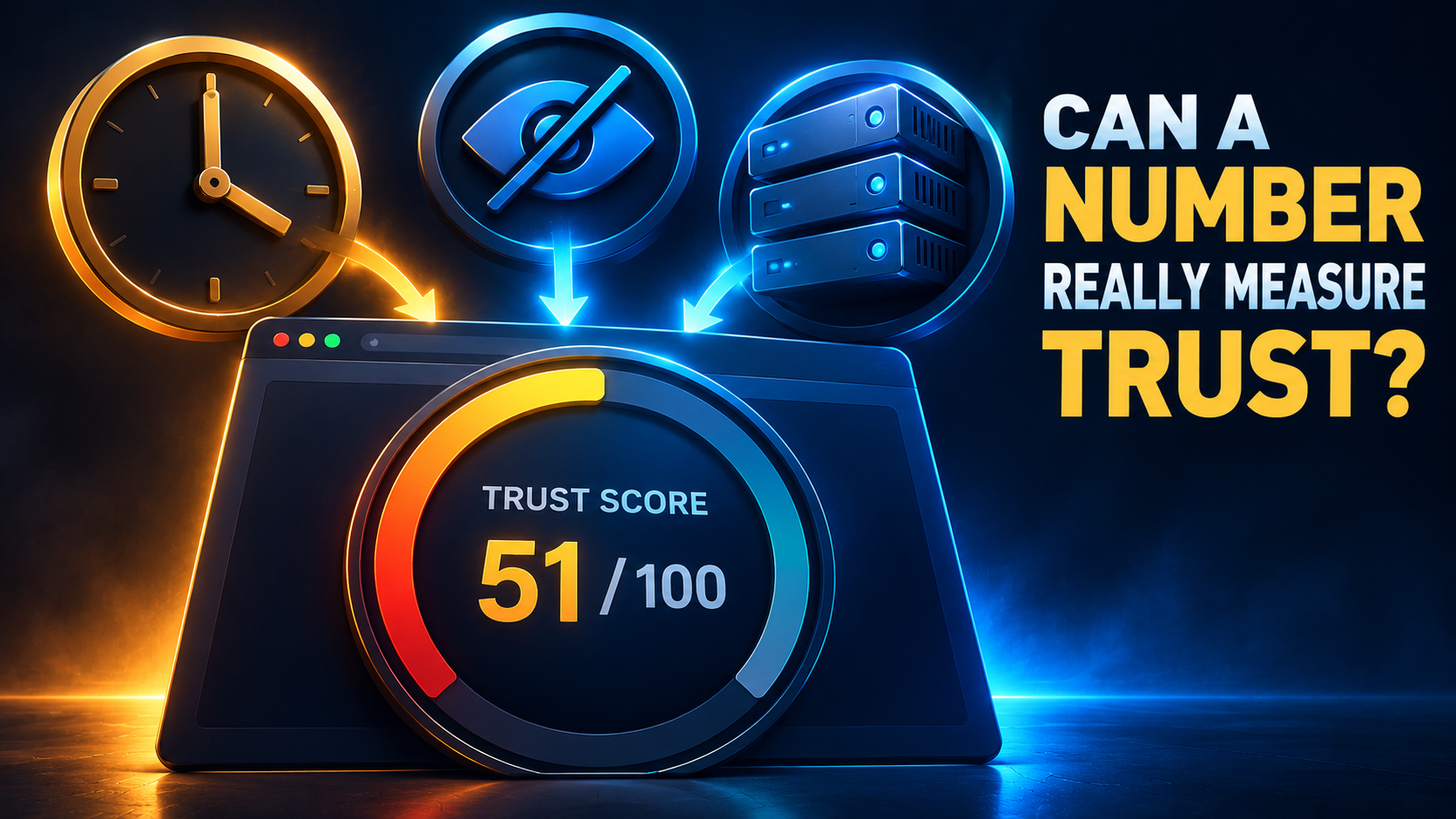
When people encounter an unfamiliar website, they often look for a quick answer to one question: Can I trust this website?
That is exactly the problem ScamAdviser.com tries to solve. Its website presents a Trust Score from 1 to 100 and categorizes websites from “Very Likely Unsafe” to “Very Likely Safe.” ScamAdviser says the score is calculated using more than 40 data sources and is intended to help consumers make safer decisions online.
At first glance, this sounds reassuring: more data, more analysis, and a numerical score should mean a better assessment.
But there is an important question that consumers should ask:
How useful is a website risk score when many of the signals behind it are indirect, statistical, incomplete, or not independently verified?
ScamAdviser itself provides reasons to ask that question.
A number can look more certain than the evidence behind it
The first problem is presentation.
A number such as 85, 51, 30, or 10 creates an immediate impression of precision. It looks as though the system has measured the trustworthiness of a website on a clearly defined scale.
But ScamAdviser itself says that its Trust Score is not a verdict. It describes the score as a risk indicator generated through automated analysis of more than 40 independent data sources.
That distinction matters.
A risk indicator is not the same thing as proof that a company is legitimate, proof that a website is fraudulent, or proof that a website has engaged in wrongdoing.
The underlying methodology is essentially an aggregation of signals. The system looks at characteristics associated with websites that have previously been considered risky and uses those characteristics to calculate a score.
That can be useful as a starting point.
But it can also create a serious problem: correlation can be mistaken for evidence.
The problem with indirect signals
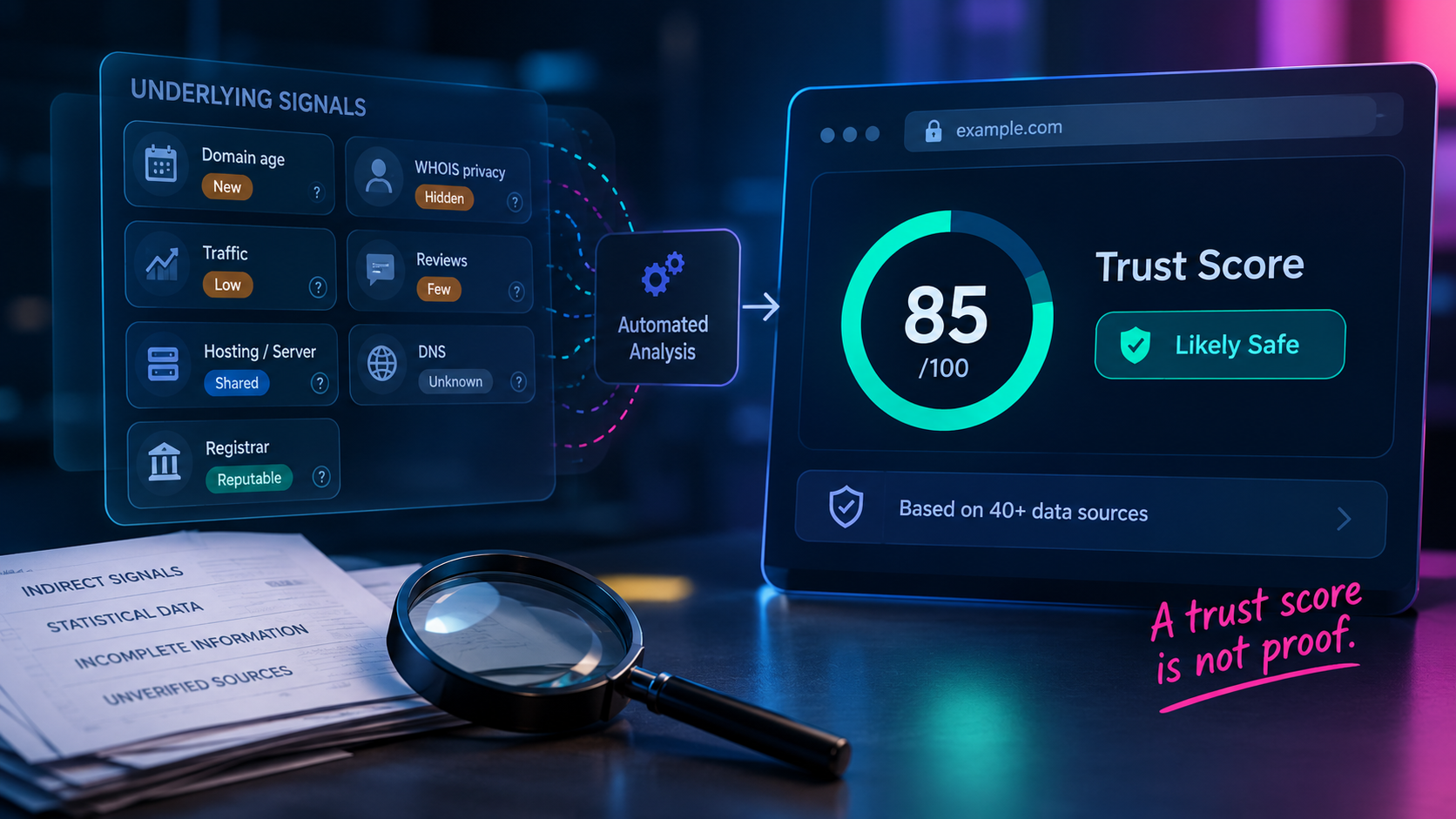
ScamAdviser says its algorithm considers many factors, including domain age, registration information, WHOIS availability, registrar reputation, server and DNS information, hosting infrastructure, traffic, reviews, contact information and other technical or reputational signals.
These signals may have statistical value.
But statistical association does not automatically tell us what an individual website is actually doing.
Consider some of the factors.
A domain can be new because somebody has just launched a legitimate business.
WHOIS information can be hidden because the domain owner uses a privacy service.
A website can have low traffic because it is new, small, specialized, local, or simply not famous.
A website can use shared hosting, meaning completely independent websites happen to operate on the same infrastructure.
A registrar can have customers that operate fraudulent websites without every customer of that registrar being fraudulent.
A server can contain unrelated websites with different owners, businesses and purposes.
None of these facts, by themselves, demonstrates that a website is a scam.
ScamAdviser acknowledges some of this itself. Its own explanation states that legitimate websites can receive lower scores because they are new, use WHOIS privacy, have low traffic, lack independent reviews, use shared hosting, or otherwise lack established reputation signals.
That is a fundamental weakness of this type of automated system.
The algorithm may correctly identify that a characteristic is statistically associated with risk.
But that does not mean the characteristic is evidence that the particular website being evaluated is malicious.
Even ScamAdviser admits that some information cannot be directly verified
This is perhaps one of the most important points.
ScamAdviser's own FAQ states that its Trust Score partly takes into account information whose accuracy cannot be directly verified by ScamAdviser, giving user ratings as an example.
That should make consumers think carefully about what a score actually represents.
If information entering the scoring system can itself be inaccurate, then the final score cannot automatically be treated as an objective measurement of reality.
It is an output produced from available information.
And if some of that information is wrong, incomplete, outdated or impossible to independently verify, the output can also be wrong.
This does not mean every ScamAdviser score is wrong.
It means something more important:
The score cannot be stronger than the quality of the evidence used to produce it.
Automated does not mean accurate
ScamAdviser openly acknowledges that false positives exist and describes its algorithm as automated and imperfect. It also invites website owners to contact the company when they believe a score is inaccurate.
That admission is reasonable. No automated detection system is perfect.
However, it also reveals the limitation of relying on the system as a primary source of judgment.
A consumer may see a large warning, a colored risk category and a numerical Trust Score and assume that the website has been thoroughly investigated.
But automated analysis is fundamentally different from an independent investigation.
An automated system can examine domain records, infrastructure, reviews and other available information.
It cannot automatically understand every legitimate business relationship, every new company, every unusual business model, every reason for privacy protection, or every innocent explanation behind a technical configuration.
The result is therefore better understood as:
“These characteristics resemble patterns our system associates with risk.”
It is not necessarily:
“We have established that this website is dangerous.”
That distinction should be much clearer to consumers.
New websites face an obvious disadvantage
Another structural problem is the treatment of new websites.
ScamAdviser explicitly says that a brand-new website may score lower because the algorithm has little historical information about it. It also identifies lack of independent reviews, low traffic and limited reputation history as reasons a legitimate website can receive a lower score.
This creates a difficult situation.
A new legitimate website starts with little history.
Because it has little history, it has fewer positive reputation signals.
Because it has fewer positive signals, automated systems have less evidence with which to establish trust.
And because it has less evidence, consumers may see the resulting score as a warning.
This creates a form of reputation catch-22.
A website cannot have years of reputation before it has existed for years.
It cannot have millions of visitors before it has attracted millions of visitors.
It cannot have years of independent reviews before customers have had years to leave them.
A scoring system that heavily relies on historical reputation therefore has an unavoidable weakness when dealing with new businesses.
New does not mean fraudulent.
Unknown does not mean dangerous.
Small does not mean dishonest.
What makes the score less useful in practice?
The central problem is not that ScamAdviser has no information.
It is that consumers can easily confuse a large quantity of signals with a high quality of evidence.
Forty signals do not automatically produce forty pieces of proof.
If several signals are merely variations of the same underlying circumstance, adding them together does not necessarily create independent confirmation.
For example, a young website may simultaneously have low traffic, few reviews, little historical reputation and limited external references.
Those may appear to be several negative signals.
But they can all originate from one simple fact:
the website is new.
Counting several consequences of the same underlying condition can make a situation appear more strongly supported than it really is.
This is why automated scoring systems require careful interpretation.
A complicated algorithm can produce a very simple number.
The simplicity of that number can hide the complexity and uncertainty behind it.
ScamAdviser itself tells users to look elsewhere
Interestingly, ScamAdviser does not claim that its Trust Score should be the final answer.
Its own materials recommend additional investigation, including independent searches and external review sources.
That effectively means the Trust Score is only a starting point.
And that raises an obvious question:
If consumers still need to independently investigate the company, verify its identity, examine reviews, check policies and research its reputation, how much weight should they place on an automated score in the first place?
A checker can be useful for finding clues.
But clues are not conclusions.
That is the distinction consumers should understand before treating a Trust Score as authoritative.
There is also a commercial side to ScamAdviser
ScamAdviser is not simply a neutral public database operating without a business model.
Its own website openly describes commercial services built around its data.
ScamAdviser provides API and data-feed services to businesses and organizations, with pricing based on API usage. Its materials describe its database as containing tens of millions of websites and offer access to its Trust Score data for commercial and professional applications.
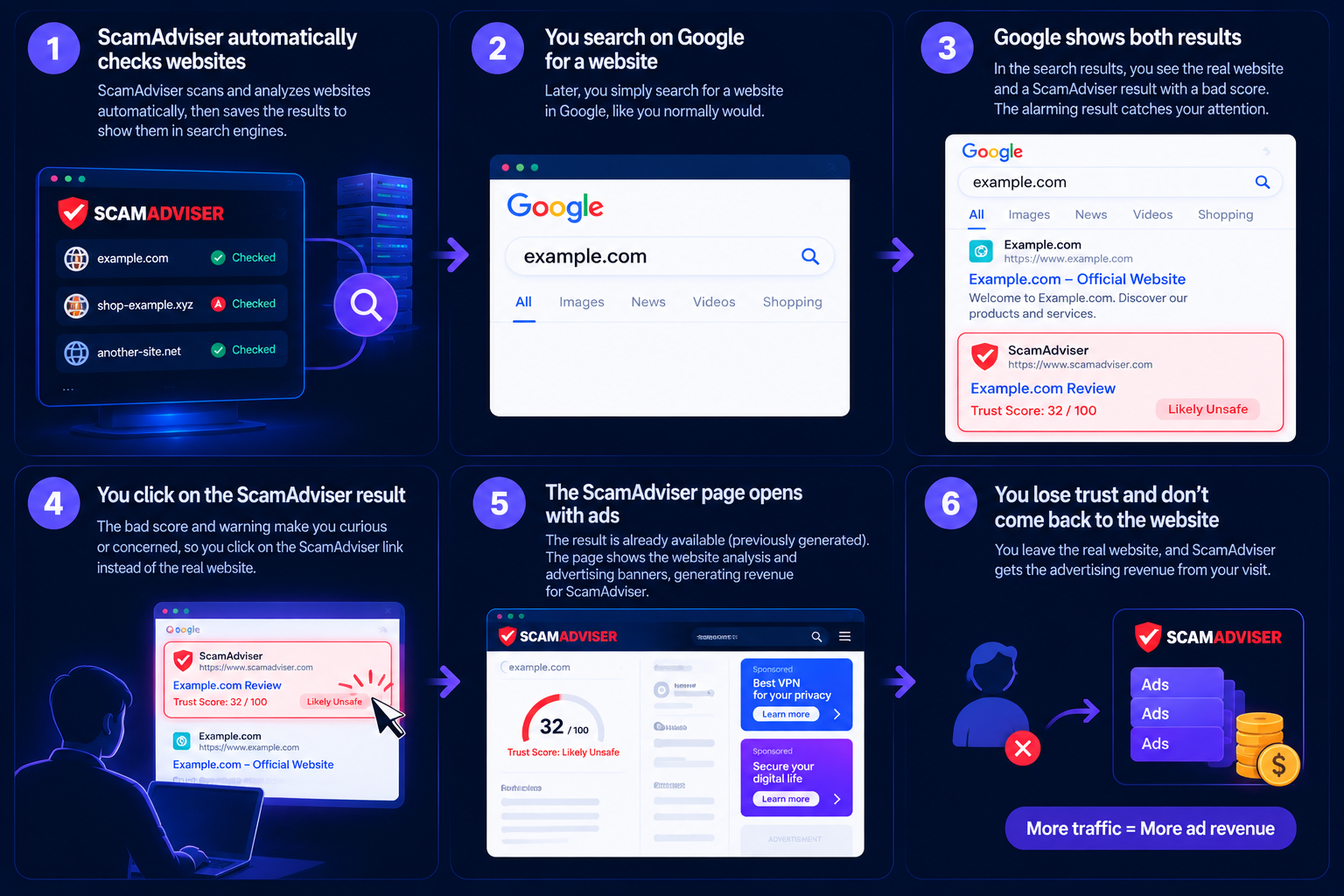
More importantly, ScamAdviser itself acknowledges that it makes money through advertising and data services. A ScamAdviser article explicitly answers the question “How Does ScamAdviser Make Money?” by stating that the company runs advertisements on its website and offers data services to other organizations.
Its advertising operation is not hidden. ScamAdviser has a dedicated advertising page describing advertising opportunities and display-advertising networks.
This matters because ScamAdviser operates at enormous scale.
Its published materials describe a database containing tens of millions of websites and the analysis of more than one million new websites.
That means website-check pages are not an incidental part of the service. They form part of a very large information platform that attracts people searching for information about websites.
The advertising question deserves attention
There is nothing inherently wrong with advertising.
There is also nothing inherently wrong with operating a commercial data service.
But when a company combines:
- automated analysis,
- enormous numbers of website profiles,
- search-oriented information,
- millions of visitors,
- advertising,
- and commercial data services,
it becomes reasonable to examine the business model alongside the information being presented.
A website-check page can serve two purposes simultaneously.
It can provide information to a consumer.
And it can bring a visitor to ScamAdviser.
That visitor can then be exposed to advertisements and other commercial services.
This does not prove that every website page is created solely for advertising revenue.
It does, however, establish that there is an economic value in attracting people who are searching for information about websites.
That is why consumers should not automatically assume that every page produced by a commercial website-checking platform represents an independent, definitive judgment.
The platform itself has a business model.
The real problem: authority without certainty
The biggest concern with ScamAdviser is therefore not that it uses an algorithm.
Algorithms can be extremely useful.
The concern is the gap between what an automated score appears to communicate and what the underlying evidence can actually establish.
A numerical score feels objective.
A long list of technical signals feels comprehensive.
A warning label feels authoritative.
But underneath all of that may be domain-age statistics, traffic estimates, reputation associations, third-party reviews, infrastructure relationships and other indirect indicators.
And ScamAdviser itself acknowledges that its algorithm can produce false positives and that some information cannot be directly verified.
That should fundamentally change how consumers interpret the result.
A checker should help investigate not replace investigation
ScamAdviser can potentially be useful when treated as one source of clues.
The problem begins when users treat it as a final authority.
A low score does not, by itself, establish fraud.
A high score does not guarantee that a website will never cause harm.
A new domain is not automatically suspicious.
WHOIS privacy is not evidence of criminal behavior.
Shared hosting does not establish a relationship between unrelated websites.
Low traffic does not establish dishonesty.
And a collection of statistical signals does not magically become verified evidence simply because an algorithm combines them into a number.
Consumers should therefore ask a much more important question than:
“What is this website's ScamAdviser score?”
They should ask:
“What actual evidence supports the conclusion, and can I independently verify it?”
That is the difference between an automated warning and genuine due diligence.
Conclusion
ScamAdviser presents itself as a tool designed to help consumers identify potentially dangerous websites. Its automated system can certainly collect useful information, and its database may provide useful clues.
But useful clues are not the same thing as reliable conclusions.
The company's own documentation acknowledges that its algorithm is imperfect, that false positives exist, that legitimate new websites can receive weaker scores, and that some information used in its scoring cannot be directly verified.
At the same time, ScamAdviser operates a substantial commercial platform supported by advertising and data services.
That combination deserves critical examination.
Consumers should be especially careful when a simple numerical score appears to turn uncertain and indirect information into an apparently precise judgment.
The most important lesson is simple: a Trust Score is not proof.
It is an algorithmic interpretation of available signals.
And when the underlying signals are incomplete, indirect, statistical or unverifiable, the resulting score can be far less useful than its polished presentation suggests.
Before trusting a website checker, therefore, check the checker itself.